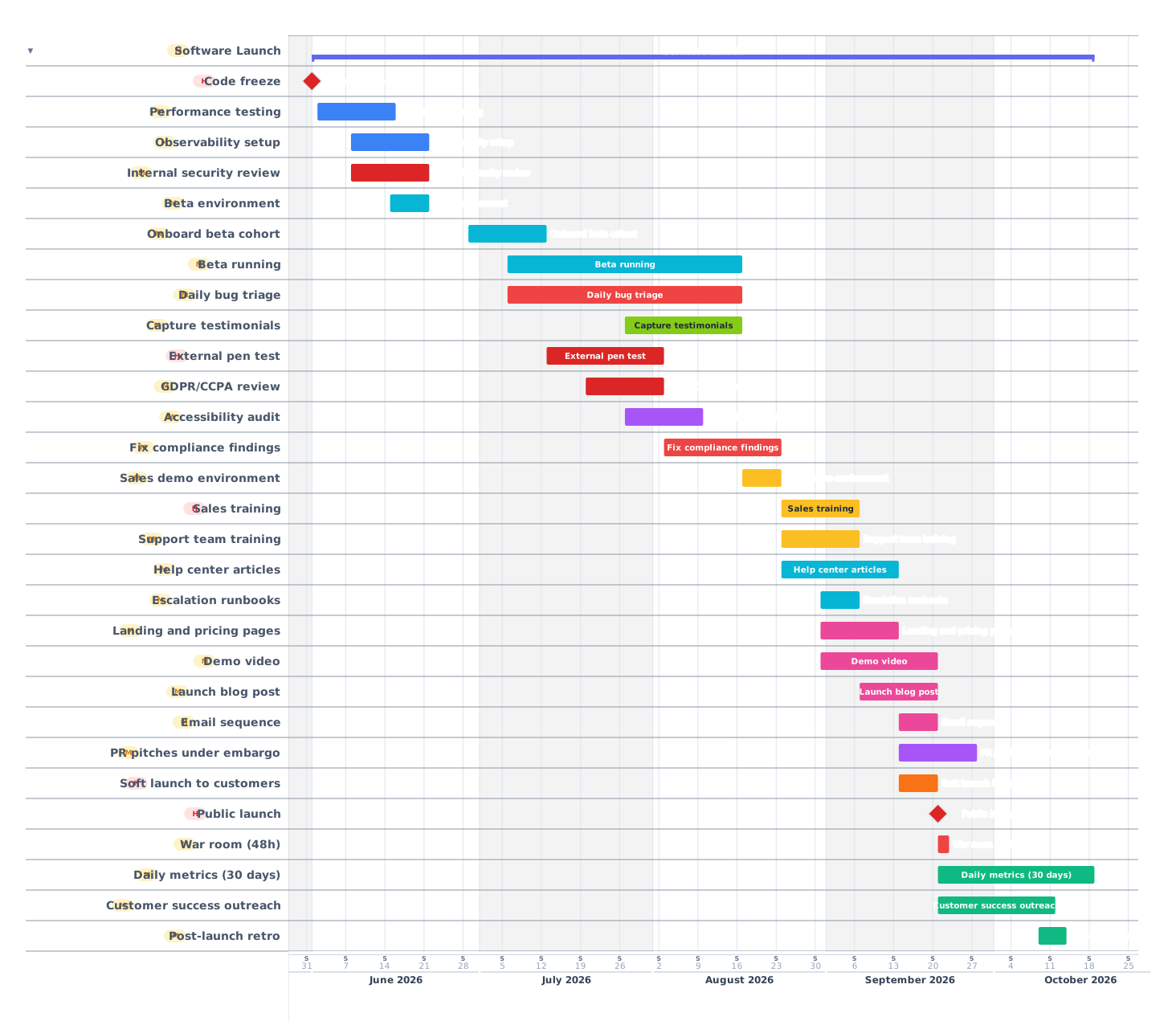
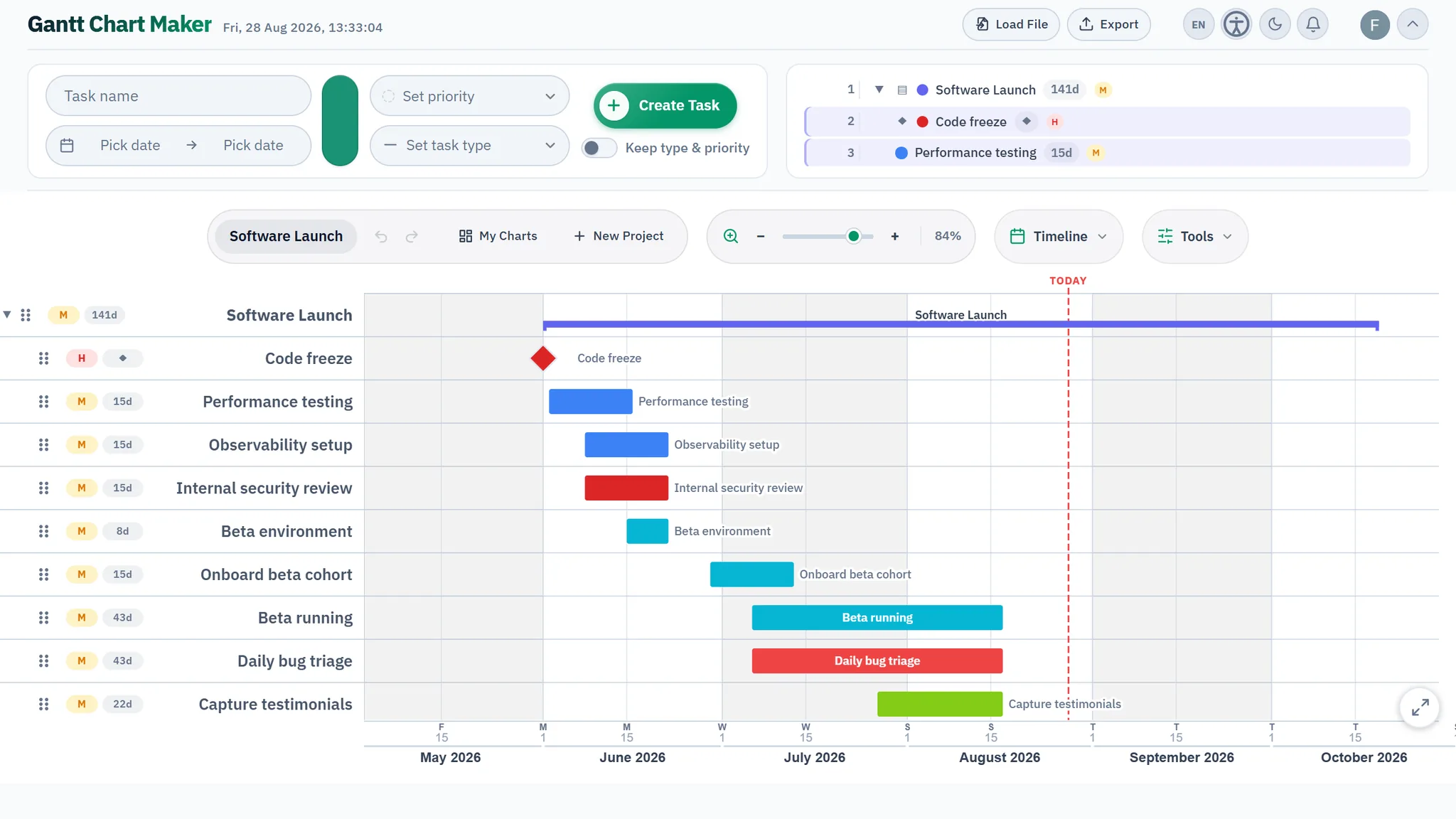
A 16-week software launch plan: engineering hardening, beta, security and compliance, sales and support enablement, marketing, launch day, and 30-day post-launch monitoring.
A software launch is two launches: the engineering launch (the system is ready, scalable, and observable) and the go-to-market launch (the world knows it exists and knows what to do with it). They have to land on the same day. This 16-week template plots both tracks in parallel: engineering hardening, security review, beta cohort, marketing buildup, and the post-launch monitoring window.
How a 16-week software launch breaks down
01
Hardening and beta prep
Weeks 1–4
Code freeze on new features. Performance testing under expected load + 2x. Observability: dashboards, alerts, error budgets. Security review of authentication, authorization, data handling. Set up the beta environment separate from production.
Code freeze on new features
Performance testing (2x expected load)
Observability: dashboards and alerts
Security review (authn, authz, data)
Beta environment setup
Beta documentation
02
Beta cohort
Weeks 5–10
Onboard 20–50 beta customers. Weekly check-ins. Track every reported bug. Triage daily. Fix the top 5 reported issues each week. The goal is not zero bugs. It is zero P0 bugs and a known list of P1s and P2s with workarounds. Capture testimonials for launch.
Onboard 20–50 beta users
Weekly check-ins
Daily bug triage
Fix top 5 issues/week
Capture testimonials
Update onboarding based on feedback
03
Compliance and audits
Weeks 6–12
External security audit (penetration test, SOC 2 if applicable). Data privacy review (GDPR, CCPA). Accessibility audit (WCAG 2.1 AA). Compliance findings get prioritized into the engineering plan. Most can be fixed in days, a few may need weeks.
External pen test
SOC 2 readiness (if applicable)
GDPR/CCPA review
Accessibility audit
Fix compliance findings
04
Sales and support enablement
Weeks 11–14
Build sales demo environment. Sales training on the new product, the new positioning, and the new pricing. Support team training. Build the support help center, FAQs, and escalation runbooks. Configure the in-app help and chatbot if applicable.
Sales demo environment
Sales training (positioning, pricing, demo)
Support team training
Help center articles
FAQ and escalation runbooks
In-app help configured
05
Marketing and launch buildup
Weeks 13–15
Landing page, pricing page, demo video, launch blog post, email sequence, PR pitches under embargo. Soft launch to existing customers 1 week before public launch to surface any final issues. The customer-first soft launch is the most-skipped step in software launches and reliably catches issues that the team missed.
Landing and pricing pages
Demo video
Launch blog post
Email sequence
PR pitches under embargo
Soft launch to customers (1 week early)
06
Launch and post-launch monitoring
Week 16
Public launch. Email blast, social, paid, PR embargo lifts. War room for first 48 hours. Daily metrics review for 30 days. Hot-fix any P0 issues immediately. Run the post-launch retrospective within 2 weeks of launch.
Public launch
War room (48 hours)
Daily metrics review (30 days)
Hot-fix P0 issues
Customer success outreach
Post-launch retrospective
Tips from software launches that landed
01Code freeze 4 weeks before launch. Late features cause late bugs.
02Run performance tests at 2x expected load. Real traffic comes in spikes; tests at 1x miss the second-day surge.
03Soft launch to existing customers 1 week before public launch. Catches issues the team missed.
04Build the war room and on-call schedule before launch day. Not after the first incident.
05Write the retrospective within 2 weeks. By week 4 half the team has moved on.
Frequently asked questions
How long does a software launch usually take?
B2B SaaS: 12–20 weeks of focused launch work after the product is feature-complete. Mobile apps and developer tools often need additional time for app-store review or developer enablement.
What is the most-missed step?
Sales and support enablement. The team building the product knows it; the team selling and supporting it has to be trained.
When should I freeze new features?
4 weeks before launch for B2B SaaS, longer for high-availability systems. Every late feature is a late bug.
 Gantt Chart Maker